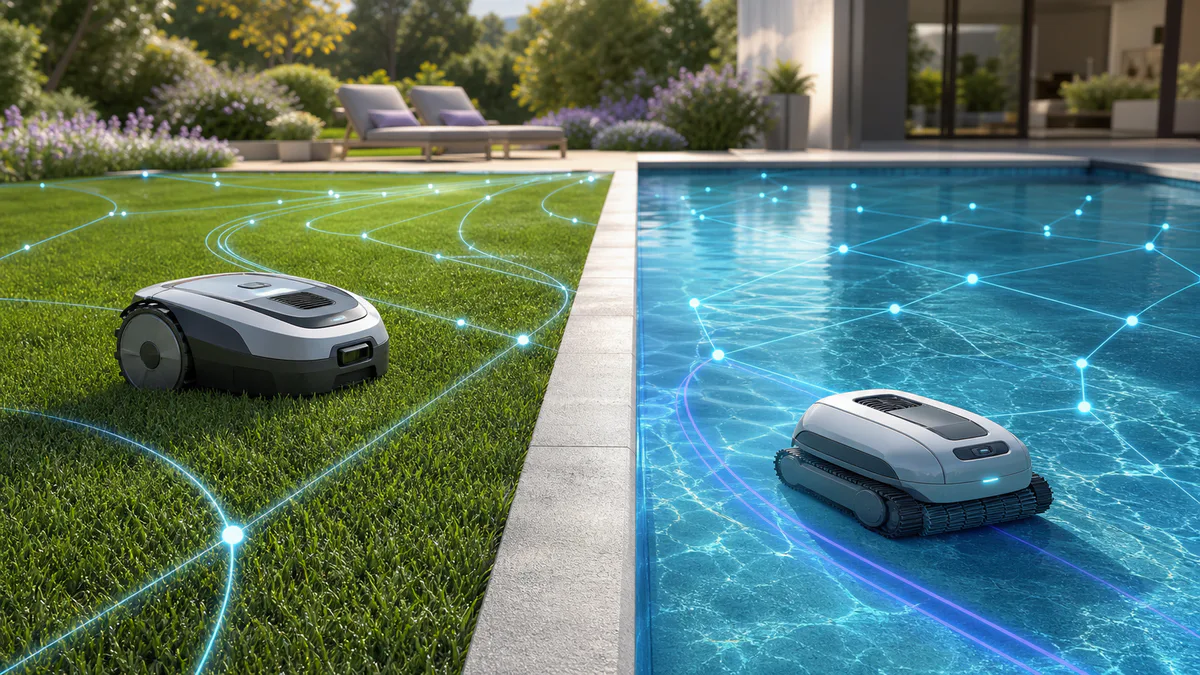

The headline spec on an outdoor home robot is usually the wrong one to fixate on. Suction figures, brush counts and blade widths are easy to print on a box. They tell you little about whether the machine will cover your yard or pool without missing patches, stranding itself or repeating the same path. The more useful question, across both categories, is how the unit perceives its environment and plans its route.
Pool cleaners: suction was never the whole story
Robotic pool cleaners were long ranked by suction power, brush configuration and how much debris they collect in a cycle. According to Robotics & Automation News, those metrics no longer capture the full performance picture, and AI-assisted navigation is now the bigger differentiator: a cleaner that maps the pool and moves through it efficiently can outperform a more powerful unit that wanders.
That tracks with what matters in practice. A high-suction cleaner on a random or repetitive path can leave dead zones along walls, steps and the waterline while spending its cycle on areas it already covered. A unit that tracks the pool's shape and its own position cleans the same surface more completely in less time. Suction and brushes still matter; they are necessary rather than sufficient.
The implication for shoppers is to read reviews for coverage and path behaviour, not just collection capacity. Manufacturers rarely quantify navigation the way they quantify suction, so independent testing over a full cycle is where the difference shows up. Our robotic pool cleaner picks weigh those trade-offs.
Mowers: the move away from GPS dependence
Robot lawn mowers are going through a parallel shift. Many current models lean heavily on GPS for boundaries and positioning, which can struggle near trees, walls and narrow passages that block or degrade the signal. The industry response is to layer additional sensing on top of, or in place of, satellite positioning.
Anthbot is one example. At spoga+gafa 2026, the company presented HoloSense, a navigation system intended to make robot mowers less dependent on GPS, as reported by Les Numériques. HoloSense combines 360-degree LiDAR, RTK, NetRTK and AI vision to help a mower orient itself in complicated gardens, with the stated goal of reliable positioning where GPS alone falters.
That sensor stack recurs across the category. LiDAR maps physical surroundings directly rather than inferring position from satellites. RTK and NetRTK sharpen positioning accuracy. AI vision adds object recognition for obstacles and lawn edges. A mower drawing on several inputs is less likely to fail in exactly the spots — tree cover, fences, tight corridors — where a GPS-only unit gives up. Definitions for these terms are in our glossary.
A note on demonstrations
HoloSense was shown at a trade event, which is a product showcase, not a verdict on how the system performs across a season of real lawns. Treat the announcement as a signal of direction, not proof of results. The same caution applies to any mower marketed on its sensor list: the question is whether the navigation holds up months later on an irregular garden, not whether it impressed on a show floor. Compare options in our robot lawn mower picks.
Why navigation is becoming the deciding spec
The pattern across both product types reflects a wider trend. The Robot Report notes continued investment in better navigation and autonomy for robots performing real-world tasks. As that capability absorbs more engineering effort, it becomes the area where competing models genuinely diverge. Cleaning and cutting hardware has largely converged; how a machine perceives and plans is where the gap now sits.
For a buyer, this reorders the checklist:
- How does the unit map its space? Random movement, systematic patterns and sensor-built maps each behave differently in a real yard or pool.
- What sensors does it use, and do they overlap? A single input — GPS only, or bump-and-turn only — has predictable failure modes. Redundancy tends to help.
- Does coverage hold up in awkward layouts? Performance on a flat rectangle says little about narrow passages, slopes, steps or shaded corners.
- Does it degrade over time? Navigation that drifts or relearns badly after months is a recurring complaint worth checking in long-term reviews.
None of this makes raw cleaning power irrelevant. A mower still needs to cut and a pool cleaner still needs to lift debris. But between two units with comparable hardware, the one that navigates better is the one that finishes the job. That is the spec increasingly worth paying for, and the one keynote demos are least likely to prove. Side-by-side specifications are on our comparison tool.
This article cites Robotics & Automation News, Les Numériques and The Robot Report for the facts referenced above.